


D&D 2014 Dungeon Master's Guide (Dungeons & Dragons Core Rulebook)
Product ID: 9335453
📚Comprehensive 300+ pages of expert DM guidance
⚔️Customizable encounter balancing for any challenge
🧙♂️Hundreds of classic & new magic items cataloged
Buy anything from 5,000+ international stores. One checkout price. No surprise fees. Join 2M+ shoppers on Desertcart.
Desertcart purchases this item on your behalf and handles shipping, customs, and support to GERMANY.
🎲 Rule your realm with the ultimate Dungeon Master's arsenal!
The D&D 2014 Dungeon Master's Guide is a 300+ page hardcover manual designed for Dungeon Masters aged 12 and up. It offers expert advice on world-building, encounter balancing, and hundreds of magic items to enrich gameplay. While not a beginner's rulebook, it is an indispensable resource for experienced DMs seeking to craft immersive, customizable adventures in the 5th edition of Dungeons & Dragons.


| ASIN | 0786965622 |
| Age Range Description | Age Range:12 Years & Up |
| Best Sellers Rank | #58 in Dungeons & Dragons Game #1,174 in Dragons & Mythical Creatures Fantasy (Books) #1,445 in Sword & Sorcery Fantasy (Books) |
| Brand Name | Dungeons & Dragons |
| Color | Multicolor |
| Customer Reviews | 4.9 out of 5 stars 30,734 Reviews |
| Educational Objective | Develop storytelling abilities and problem-solving skills through creating and managing engaging game sessions for the Dungeons & Dragons role-playing game. |
| Global Trade Identification Number | 09780786965625 |
| Included Components | HC Book |
| Is Assembly Required | No |
| Item Dimensions | 8.51 x 0.85 x 11.17 inches |
| Item Type Name | Tabletop Game |
| Item Weight | 1.11 Kilograms |
| Manufacturer | Wizards of the Coast |
| Manufacturer Maximum Age (MONTHS) | 1188 |
| Manufacturer Minimum Age (MONTHS) | 144 |
| Manufacturer Part Number | 786965622 |
| Material Type | Paper |
| Model Number | A92190000 |
| Number of Batteries | 1 Lithium Ion batteries required. (included) |
| Number of Players | 2-5 |
| Operation Mode | Manual |
| Power Source | Manual |
| Size | 0.85 inches x 8.51 inches x 11.17 inches |
| Subject Character | Monster |
| Theme | Adventure, Fantasy, Magic |
| Unit Count | 1.0 Count |
B**W
Everything a newbie DM could ever want to know about being a DM
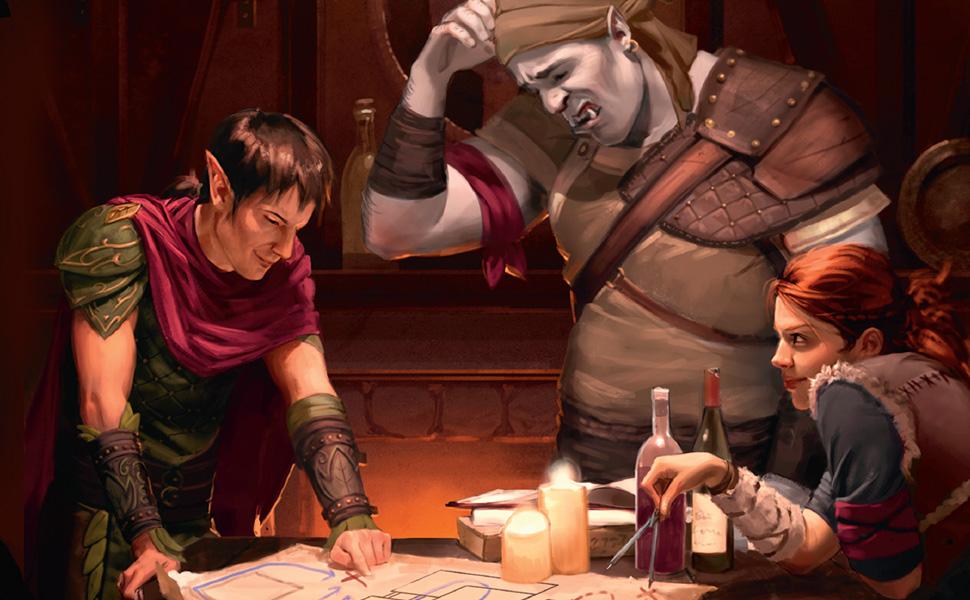
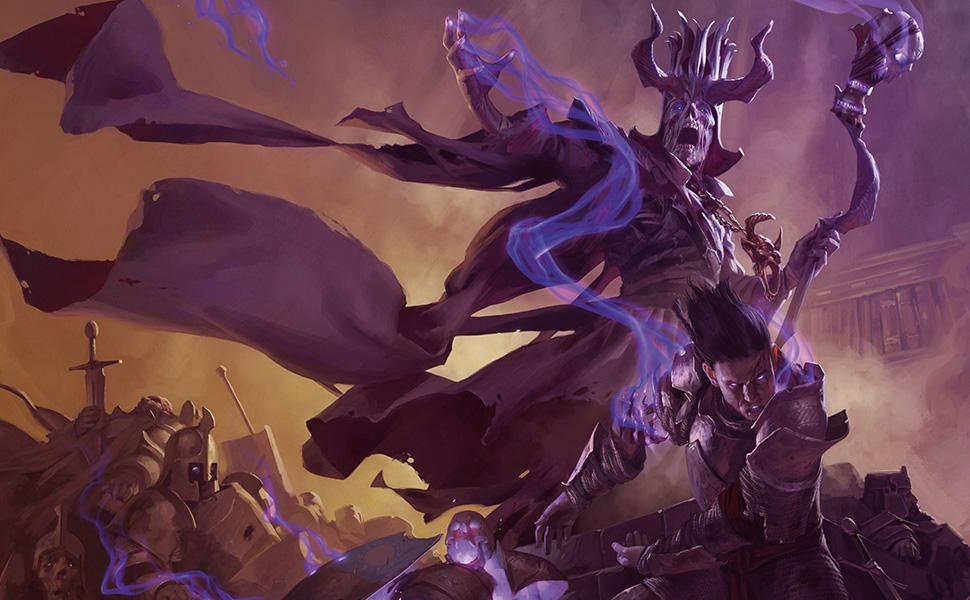
Previously, I wrote a review for the 3.5 edition of the Dungeon Master's Guide for Dungeons and Dragons, and I useful I found it for writing novels. All of that applies to the 5th edition too, but more so. I much prefer this edition as a writing aid. Oh yes, I also find it useful for running a Dungeons and Dragons campaign. This book is split into three main sections, each describing the responsibility of the Dungeon Master in the game. They are "Master of Worlds", "Master of Adventures" and "Master of Rules". The first is for creating the campaign world, the second is for creating the adventure, and the third is a list of rules to help the DM run the scenario, tweak situations to fit the campaign, and a section with advice on homebrewing elements. As a Dungeon Master, I find this book extremely helpful. I have several areas of it bookmarked for easier and quicker reference. One of them is the area for building encounters and managing random encounters. This helped break my previous conception of random encounters, which I picked up from video games. In video games, there is no point to a random encounter other to beatdown on the monsters for some droppable resource (Experience points, money, some form of loot). Then you move on. Not so in a Dungeons and Dragons session, where some groups play for 2-3 hours a week or even less. That can become tedious (as it sometimes happens in video games as well). This area of the book taught me how to make a random encounter more meaningful. There is a "Sylvan Forest" encounter table in here that I merged with another table in the Monster Manual to create the one for the area that my party is currently adventuring in. These "random" encounters provided the seed necessary to create events that are relevant to the here and now of the session. I also bookmarked the area that explains how to create maps for dungeons, settlements and wilderness, as well as adjudicating and describing what your players do in each. Because each area is different, different methods are used for each one. For instance, a dungeon is likely to be traversed room-by-room, as the player-characters check for traps and treasure. The wilderness, by contrast, is more likely to be a more general environment that does not involve the player-characters checking behind each tree or the top of each hill. Unless, of course, they are in a particular section of wilderness that doubles as a dungeon. Also, my players have done a lot of foraging recently so it is useful to have a table that enables me to quickly determine if they find something and how much they find. A third bookmark, of which I currently have seven in total, is a rule variant for chases. In Dungeons and Dragons 5th Edition, all creatures have a set movement speed, which makes chases deterministic and therefore less interesting. This area lists certain rules that can be used to add randomness to this otherwise pre-determined scenario, basically obstacles that both the pursuer and the quarry can run into, which can slow them down. There are also rules for determining when the chase begins, ends, or turns around and makes the hunter the hunted. Oh, I wish I had read this book cover-to-cover when I first started DMing. I thought I knew the rules well enough as a player and that I would do fine by imitating what our group's original DM did, but I didn't do fine. Not in the least. I have several embarrassing sessions under my belt, and this book could have prevented several of them. Particularly the Chase section; especially the Chase section. On another note, there is gorgeous art in this book. This review is mainly about the usefulness of the book for a Dungeon Master (and therefore also a novelist) but I have to mention the gorgeous art. You can see landscapes of everything from mountains and meadows to the Shadowfell or the Elemental Plane of Fire. You get portraits of an adventuring party consulting/drawing a map or in combat with a dragon. Most of the magic items listed in the treasure also get their own images along with their listing. Trickster Eric Novels gives "The Dungeon Master's Guide for D&D 5E" an A+
S**N
A Classic; DON'T buy this one first
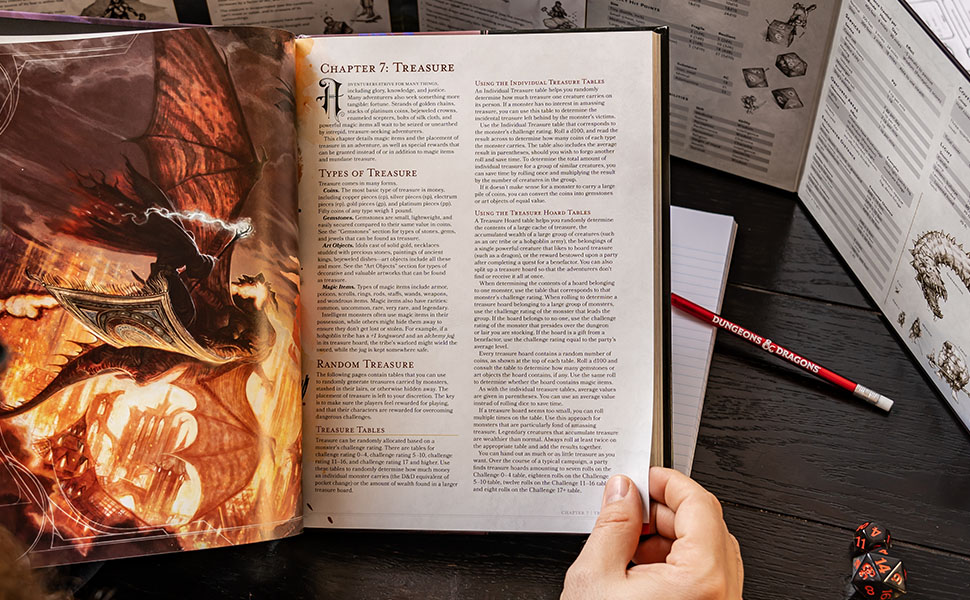
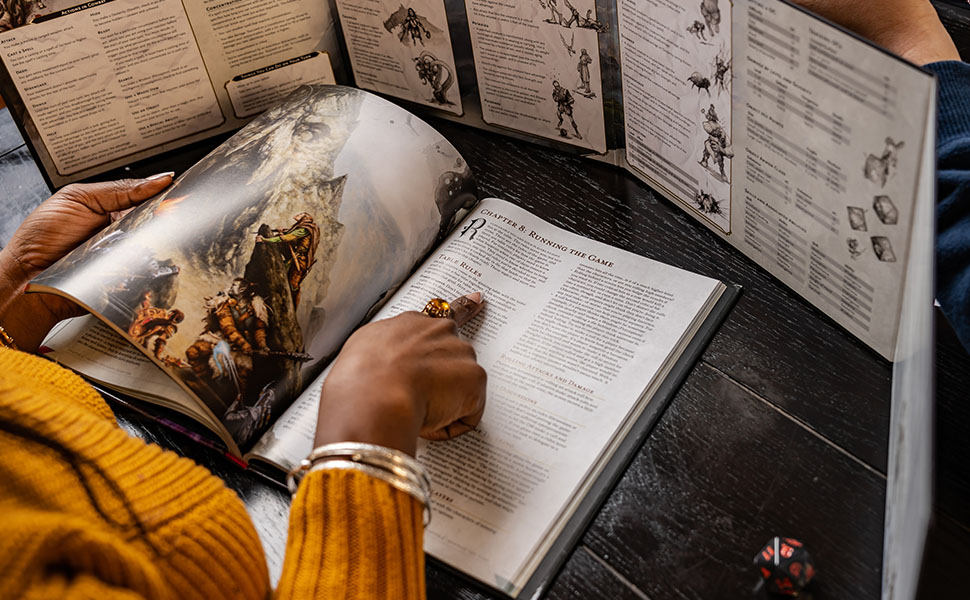
It's a common mistake for newbies to lean into the Dungeon Master's Guide in an effort to learn the game. I think it's weird that Wizards decided to market this as "All you need to run a Dungeons & Dragons game", because the DM's Guide doesn't actually tell you how to play D&D. It contains none of the essential rules. If you're approaching D&D for the first time, you should buy The Player's Handbook. Every single player and DM needs to know about Ch. 7 Using Abilities, Ch. 8 Adventuring, Ch. 9 Combat and Ch. 10 Spellcasting - this is the heart of the game. Once you're comfortable with the basics, you need to start customizing your game with "house rules", optional rules that work well for your group and playstyle. Your game will naturally flow between epic storytelling and gritty tick-tock action. Your players will do inspiring things worthy of reward. You'll sometimes need to ignore the dice, or follow the "Rule of Fun". The Dungeon Master's guide has solid, time-tested advice on all of that and more. Unfortunately all the good stuff is crammed in to Part 3; the DM's guide hasn't changed that much since the original bound AD&D version, including the awkward arrangement of chapters and information. Ch. 3 "Creating Adventures" and Ch. 5 "Adventure Environments" are important reads, and Chapter 8. "Running The Game" is what you think you're getting when you buy this - practical, detailed advice on running a D&D game. I really like Chapter 6 "Between Adventures", which helps you fill in the gaps with careers, philandering, politics and real-estate. All of Part 1 may as well be supplemental. It helps as background material for the official adventure modules, and can help ground your homegrown campaign in some official lore, but it's by no means essential, and you could get bored and discouraged if you tried to learn D&D by slogging through the differences between Arcadia vs Archeron vs Avernus. Save it for later. Chapter 7: Treasure. Ah, treasure. This is the other reason to get this book: it's the best all-in-one official sourcebook for D&D treasure. The stuff of legends. Some of this stuff - Boots of Elvenkind, Bag of Holding, Belt of Giant Strength - has been in the game 30+ years. There's newer treasure as well, and it all feels appropriately quirky and powerful. Old-school DMs have a reputation of granting treasure sparingly, and Chapter 7 has suitably stingy (but useful) random treasure tables, and additional random tables to give each magic item special characteristics - who made it and why, how is it activated, does it have a name? I like to hand-write the magic item's name, characteristics, background and quirky details on a 3x5 index card and hand it to players when they identify it - it makes getting one a little more special. All in all, the Dungeon Master's Guide is an absolute classic, but not an essential classic. You could play for a year before needing to crack it open, and I recommend buying The Player's Handbook and Monster Manual first. But once you've gained some experience as a DM, it provides tons of useful knowledge.
C**N
You've nailed it Wizards of the Coast.
Wizards of the Coast have finally nailed it. This book concludes the trilogy of hardbacks for the latest edition of Dungeons & Dragons. The short is that I am impressed - it's an excellent offering. The sum total of the Player's Handbook, Monster Manual and Dungeon Master's Guide provide a commendable edition. The layout of the DMG is very tidy and logical. I loved the 1st edition DMG but it was esoteric and disjointed, while the 2nd and 3rd edition DMGs were largely superfluous besides the xp tables and magic items. By contrast this Dungeon Master's Guide retains all the elements of each edition that made them great. It provides sound advice for crafting anything from a one-shot adventure, to an iconic campaign. The artwork and illustration is beautiful, and the content makes allowances for a variety of play-styles and personalities. Most of the knowledge can be acquired through practicing the art of Dungeon Mastering, however for the beginner (and even the veteran) there is plenty of inspired information, making the task truly pleasurable rather than a task. Despite having run a variety of editions, I still found myself impressed and inspired. For those who enjoy running minimalistic games, this may not be for you. There is a lot of information here, particularly a hefty section on magic items and designing encounters. It was an interesting choice to include fairly comprehensive planar information in one of the chapters (not necessarily a bad choice, merely interesting), as it saves those playing 5th edition from buying a mostly useless 'Manual of the Planes' equivalent. It's cool that they combine aspects from a range of settings, not restricting the Dungeons & Dragons experience to the high fantasy of Forgotten Realms. For those who home brew (which I preference far above any commercial setting) you are well catered for here. I personally found the 'fluff' to be the best part of the book. When I begin my next 5e campaign I will be removing xp entirely (per an optional rule) and simply awarding levels ad hoc. I find this system far preferable to keeping track of xp minutia and designing perpetually 'balanced' encounters. This may be excitement speaking rather than true objectivity, but I can strongly recommend this. I'm fairly critical, but it's ticked all of my major boxes. Thanks for finally listening to the community Wizards, you've created a winner.
K**N
The Ultimate Guide for Every Dungeon Master!
The Dungeons & Dragons Dungeon Master's Guide is a cornerstone of the D&D roleplaying game, earning a solid five stars for its depth, practicality, and inspiration. This core rulebook is an indispensable resource for any Dungeon Master (DM) looking to create engaging and memorable campaigns. Comprehensive Content: The Dungeon Master's Guide is packed with everything a DM needs to run a successful game. It covers a wide range of topics, from world-building and storytelling to rules for creating adventures, handling encounters, and managing campaigns. The guidance provided is thorough and insightful, making it an invaluable tool for both new and experienced DMs. Practical Advice: The book offers practical advice on a variety of topics, including how to handle player dynamics, create compelling narratives, and balance game mechanics. The tips and strategies provided are grounded in real gameplay experience, helping DMs navigate the challenges of running a game smoothly and effectively. Inspiring Ideas: One of the standout features of the Dungeon Master's Guide is its ability to spark creativity. The book is filled with ideas for plot hooks, adventure seeds, and unique encounters. It encourages DMs to think outside the box and craft personalized stories that captivate their players. Detailed Guidelines: The guide includes detailed guidelines for designing everything from dungeons and cities to magic items and NPCs. The sections on treasure and magic items are particularly useful, offering a wide array of options to enhance the gameplay experience. The tables and charts are well-organized, making it easy to reference important information quickly. Beautiful Artwork: The Dungeon Master's Guide is beautifully illustrated, with stunning artwork that brings the world of Dungeons & Dragons to life. The visuals add an extra layer of immersion, helping to set the tone and atmosphere for any campaign. User-Friendly Layout: The book is well-structured and easy to navigate, with clear headings, concise explanations, and helpful sidebars. The index and appendices are comprehensive, ensuring that DMs can find the information they need without hassle. Versatility: Whether you are running a high-fantasy epic, a dark and gritty adventure, or a whimsical quest, the Dungeon Master's Guide has something to offer. Its versatility allows DMs to tailor their games to suit their unique vision and the preferences of their players. Enduring Value: The Dungeon Master's Guide is a timeless resource that continues to be relevant across different editions of Dungeons & Dragons. Its enduring value lies in its ability to elevate the quality of gameplay and storytelling, making it a must-have for any serious DM. Conclusion: The Dungeons & Dragons Dungeon Master's Guide is the ultimate companion for any Dungeon Master. Its comprehensive content, practical advice, inspiring ideas, and beautiful artwork make it an essential resource for creating unforgettable adventures. This guide truly enhances the D&D experience, earning it a well-deserved five stars!
M**T
Great job with the 5th edition DMG
Excellent update to the rules. I started with the blue box Basic set in the late 1970s, and quickly transitioned to 1st edition AD&D... lost touch for many years after 2nd edition was published while I was in college. A group of old friends decided to put a game together with the Pathfinder rules last summer, and just a month or two ago we discovered 5th edition. Taking this book on its own terms: great artwork, great build/print quality, great organization of materials. Occasionally the thing they do with art to make the pages look aged/made of parchment/torn is distracting... I would go with less of that. The overall artwork though is a lot more professional throughout compared to the 'hit or miss" artwork of the 1st edition rulebooks when the game was just getting off the ground. Taking the book in context of 5th edition, as an old 1st edition player who has played a lot of Baldur's Gate/NWN/Planescape Torment, and investigated just a bit about the subsequent iterations of the tabletop game, and has been immersed in 3.5/Pathfinder rules for about a year: The simplicity/streamlining of the game mechanics is very nice. I like the Advantage/Disadvantage mechanic replacing a whole host of circumstancial bonuses and penalties, and the reduction of most game die rolls to d20 plus proficiency bonus and/or ability score bonus. Additionally, the enormous streamlining of how to handle actions and movements from the 3.5 rules is a huge benefit. Honestly, we've just been ignoring most of those rules anyway and leaving up to DM's discretion. From a strictly DMG perspective, I really love the chapters on building a campaign and the discussion of different types of players and suggestions about what to include to keep diverse player types interested in the game. This is a body of knowledge that just didn't exist 40 years ago when the game was just getting started, and will be hugely important to young DMs and valuable even for older players like me who didn't DM much in the past. I admit that I have just skimmed some sections at this point, but as far as this book specifically goes, I most appreciate the large amount of space devoted to helping a DM build a campaign world at large, medium and small scales and create adventures for it.
D**T
Guiding the Adventure—and the Heart—Through Every Journey! 🎲🕯️✝️
This D&D Dungeon Master’s Guide is truly a treasure trove for anyone who feels called to lead a game—and a little soul—on extraordinary quests. From the moment I cracked open the hardcover, I was impressed by its depth and wisdom: world-building insights, advice for crafting memorable NPCs, guidelines for running balanced encounters, and rich moral frameworks that invite meaningful storytelling. 💡 What I love most: Creative Inspiration – Endless lore, story hooks, and troublemaking ideas that spark imagination and conversation. Clarity and Confidence – Whether you're a brand-new DM or a seasoned storyteller, this guide gives you the tools to run smooth, exciting sessions that draw players in. Heart and Purpose – Beyond rules and mechanics, there’s a deeper invitation to guide others through stories that reflect hope, courage, redemption, and fellowship. As I read through the Guide, I couldn’t help but see parallels to life—and leadership—in Christ. Just like a Dungeon Master shepherds their party through challenges, Jesus guides us, sustains us in trials, and empowers us to face the unknown with wisdom and love. The unfolding adventures we shape echo His call to walk with integrity and courage in every “campaign” of life. If you’re considering this essential book, know that it delivers not only practical tools but also timeless inspiration—encouraging you to weave stories that resonate with truth, friendship, and purposeful leadership. Highly recommended for every DM who wants to lead their party—and their hearts—with boldness and grace. 🙌🎯🙏
S**E
Very good, few errors that were ever that serious, couple bad ideas in the actual manual
This was exactly as I expected, sadly it came in the snail mail making the wait agonizing. I was excited for this because Fifth Edition is the first edition i'm starting with, I found myself eager and dug right in. I did notice that this book did a great explanation of a lot of things a dm will need to know along with bonus ideas a dm could use optionally (some of which seem like bad ideas). I noticed a few glaring errors that made me stop and read over a few lines in order to continue on but other than that it is wonderful. I recently Dm'd my first game ever and it was a blast having this and the player's handbook on hand for it, everyone was completely new as well and we all laughed as we went on looking in the books only as needed. The ideas i refer to that a dm could use would be the dm points which essentially break down to changes in a campaign such as a player being able to throw a curveball into the story. It can be fun but there are other selections to this dm points (I'm not referring to inspiration but something else altogether) In which a player can use a point to change out as the dm which seems rather high of a chance to be really bad. Of course i can't exactly articulate my thoughts certainly not as much as some of the other reviews so I'll have to leave it on this note. I hope at least this review was more than just Jargon and could be somewhat coherent for anyone reading it.
S**T
5th Edition REVIEW and Book review
I bought this and the monster manual after buying the players handbook. They arrived on time and in great condition. The quality is great, book is sturdy and well bound, pages are well laid out and the pictures are great (for the most part). As for whether 5th edition is good, well.... it is fantastic. I was using 3.5 for the longest time. Played a fare share of pathfinder. I am now fully convinced that 5th edition is the closest to Tabletop perfection that Wizards has come so far. It is less complicated than 3.5 (in a good way) and just does everything well. The DM Guide gives the DM more free domain to change things and make the game their own without being corrected by players about rules. The rules are now more like guidelines so it allows more freedom in campaign and world creation (As long as your DM isn't a player killing zealot, this is a good thing). After DMing a few sessions i have managed to convert a hardcore pathfinder player and several 3.5 players and a 4th edition player. If your worried this will be like 4th edition, don't be. This version feels like the natural progression that 3rd should have taken. If your a fan of 4th then you should know that 5th changed things up quiet a bit but kept some of the better concepts that 4th introduced. Overall this is a great book and a great edition to the wonderful game of D&D.
O**.
Original
Not sealed in plastic shrink wrap but it is New and unused. almost 30% cheaper than buying it locally. so i can't complain. Perfectly Good for what it is.
P**S
Fenomenal para melhorar sua mestragem
Esse livro aborda uma gama tão grande de quesitos que mestres geralmente tem de levar em consideração, e consegue fazê-lo de uma forma que todos conseguem entender seu conteúdo (exemplo: você não precisa ser um geógrafo para entender a explicação que o livro dá sobre demografia e geografia. Basta apenas ler). Não é necessário para mestrar, afinal de contas, a única coisa que vc realmente precisa para jogar RPG é imaginação, mas com certeza é um excelente produto pra você conseguir deixar suas aventuras muito mais ricas, críveis e épicas.
A**E
Really nice book, least useful of the core books though and you can (and will probably) DM without it
Beautiful book, has the nicest cover and feel by a mile out of the 3. Has some interesting lore in it. Honestly, if you want to be a DM, really your main point is to learn the Player's Handbook off by heart. The book's split into 3 parts, Part 1, Part 2 and Part 3. Here's a rundown of what you get. Honestly, chapters 1-6 are nice for a bit of inspiration, but 6 onwards is really what you're buying this for. As a DM though you'll probably spend way more time in the PHB. I glance at this like once in a blue moon, it's not the type of thing you need on hand if you print yourself all the most useful bits and bobs for your DM screen. Part 1 (Master of Worlds): Chapter 1, which is about world building. Tbh this is very generic advice and it's mostly naturally intuitive anyway, but even if it wasn't you'd probably be best with like, a Kobold guide to Worldbuilding. Chapter 2 is about their setting's planes of existence, which is fairly useful if you want to use a generic setting and you think your campaign will last long enough to get into alternate planes. Part 1 I find pretty superfluous. Part 2 (Master of Adventures): Chapter 3: 10% of the chapter is super important - shows the rules for creating encounters. Useful because the online ones don't seem to actually work very well. 90% of this chapter however is "roll on this d20 table to invent a plot". Like, really, do people do that? Either you're going to invent your own worlds on the fly or you're going to use an adventure module. I mean, you can read this for ideas, but who is going to roll a d12 to find out what the climax of their adventure is? Chapter 4: Roll to make an NPC, same as chapter 3 (at least this is more likely if you quickly had to put something together). More importantly, contains Oathbreaker Paladin and Death Domain for the cleric. These are cool things to spring on a player who falls to the darkside. Also optional rule for Loyalty is in here, you may find useful. Chapter 5: Roll to make a world. Only really useful thing here are sample traps. (Again, read it for inspiration but not really useful). Chapter 6: Shows downtime rules. Useful if you break up your campaign that much? I tend to leave mine on cliffhangers and pick back up straight where we left off though. Nice after a campaign finishes and you want to give your PCs cool new bonuses though. CHAPTER 7: Finally things get good. This chapter is 99 pages on its own. Contains the rules for treasure drops, and then an absolute TONNE of magic items. Worth the buy just for that. Unless you can grab a copy of Forged In Magic: REFORGED perhaps. Part 3 (Master of Rules): Okay here's the entire point of the book. Chapter 8 contains all combat rules, ability checks, inspiration, travel, object use, improvising damage, using battle grids, adds flanking, chases, diseases, sieges, poisons, madness, potion crafting, ways to award xp, how to deal with absent players. Chapter 9 contains ways to modernise it with weapons and use alien technology, some combat options, and otherwise is a homebrew chapter that shows how to make monsters, spells, magic items, backgrounds. Appendices: A: Roll to make dungeons. B: Lists of monsters from the Monster Manual based on environment! Like Arctic, coast etc - super useful. Wish Tome of Beasts had this. Also based on CR. C: Some generic maps. I mean, it's beautiful, the writing is quality and I guess most of it is generically useful to all DMs but it feels like the first half is more for people who don't like to come up with their own material. It's the least useful of the 3 books though. You could probs live without it given that encounter and loot generators exist online and they're the main use, as long as you're comfortable with combat. (Which, tbh is mostly in the PHB anyway).
A**D
5e Essiential
The only thing to improve this great guide are tabs.
N**S
Good
Produkten är en bok, vad kan jag säga?
Trustpilot
1 day ago
3 weeks ago